Class A fire-rated roofing in Los Angeles
Class A is the highest fire rating a roof covering can carry. The rating comes from standard fire tests and applies to a complete assembly: the roofing, the underlayment beneath it and the way they are installed together. We install Class A roof systems in asphalt shingle, tile and metal, on existing homes in fire hazard zones and on rebuilds in Altadena and Pacific Palisades.
- Service
- Fire-rated roofing
- Contractor
- LA General Builders, CSLB Lic #1044686
How roofs catch fire, and what stops it
In a wind-driven wildfire, most houses that burn are not reached by the flames first. They are lit by embers that land on the roof, collect in the gutters or blow in through the vents and under the edges of the roofing. A fire-rated roof is built to deal with both: a covering that resists burning, and closed gaps that keep embers out.
The Class A rating itself comes from testing a complete assembly, so the details of the installation are part of the rating. Changing the underlayment or the way the roofing is fastened can change the result. We install the assembly as it was tested and keep the manufacturer's documentation for you.
-
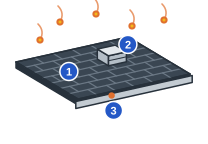
How embers reach a roof
They land on the surface (1), blow in through vents (2) and collect in gutters (3).
-
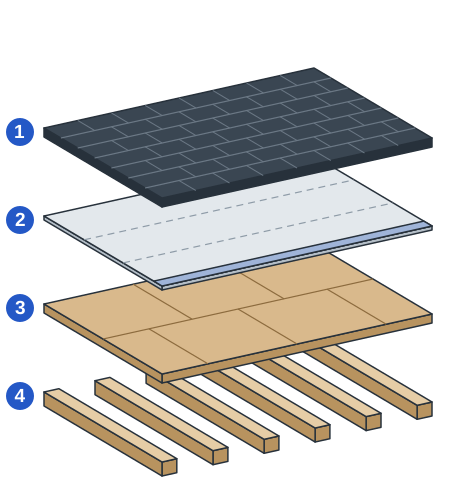
Rated as a whole assembly
Class A is tested with the roofing (1) and underlayment (2) together, over the deck (3).
-
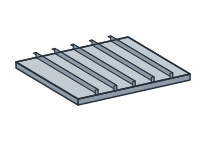
Shingle, tile or metal
Each can be a Class A roof. It depends on the exact product and what is installed under it.
What makes a roof resist fire
Embers carried by wind start most roof fires. A fire-rated roof deals with the covering and with the gaps where embers get in.
- A roof covering and underlayment tested together as a Class A assembly
- Closed gaps at the eaves and ridge, including the open ends of curved tile
- Metal edge flashing and metal valleys
- Ember-resistant vents in place of open mesh vents
- Flashing where the roof meets walls, chimneys and skylights
- Gutters that can be kept clear of dry leaves
How the job runs
The same steps on every job, from the first look at the roof to the final inspection.
Check what your address requires
We confirm with the building department whether the property is in a designated fire hazard zone and what roof rating the code requires there.
Specify the assembly
We choose a roof covering and underlayment that are listed together as Class A, and give you the manufacturer's documentation.
Written scope and price
The scope names every layer of the assembly, plus the vents, edge metal and closures.
Tear off and repair the deck
On an existing home the old roof comes off and damaged decking is replaced. On a rebuild we start from new sheathing.
Install to the listing
The assembly is installed the way it was tested, because a change in underlayment or fastening can change the rating.
Inspection and paperwork
We meet the inspector and give you the product and assembly details, which insurers sometimes ask for.
Class A roof systems
Each of these can reach a Class A rating. Whether a specific roof does depends on the exact product and what is installed under it.
| Option | Best for | Good to know |
|---|---|---|
| Asphalt shingle | The lowest-cost route to a Class A roof | Many shingles are Class A rated over the underlayment the manufacturer specifies. |
| Clay or concrete tile | Homes where tile suits the architecture | The tile does not burn. The gaps under curved tile have to be closed at the eaves, and the underlayment matters. |
| Standing seam metal | Low slopes and modern designs | The metal does not burn. The rating depends on the underlayment beneath the panels. |
| Flat roof membrane | Low-slope roofs | Rated as an assembly with the layers beneath the membrane. |
What sets the price
- Roof area, pitch and height
- The roof covering you choose
- The underlayment the Class A assembly calls for
- Vents, edge metal and closures to be replaced or added
- Deck repairs on an existing home
- Whether the roof is part of a full rebuild
Permits and inspections
Building codes in designated fire hazard zones set a minimum fire rating for roofs, and the requirement depends on the address. We confirm it with your building department before we specify the roof, pull the permit and meet the inspector.
Questions homeowners ask
What does Class A mean?
It is the highest of three fire ratings for roof coverings, Class A, B and C. A Class A assembly has passed the most severe of the standard roof fire tests.
Does my roof have to be Class A?
That depends on where the property is. Building codes in designated fire hazard zones set a minimum rating. We check the requirement for your address with the building department.
Is a tile or metal roof automatically Class A?
No. The rating belongs to the whole assembly. The same tile or metal panel can carry a different rating depending on the underlayment beneath it and how it is installed.
I lost my home in the fire. Where do I start?
Call us and tell us where you are in the process. We build complete fire rebuilds and can also install the roof alone on a home another builder is framing. One company answers for the roof and, if you choose, the house.
Will a Class A roof lower my insurance premium?
Insurers set their own rules, so we cannot promise that. We give you the product and assembly documentation to send to your insurer.
Get a price for your roof
Tell us about the roof and we will call you to set up a visit. Or call now and talk to an estimator.
818-741-5451See a price range in about a minute
LA General Builders, 8728 Zelzah Ave, Northridge, CA 91325
CSLB Lic #1044686